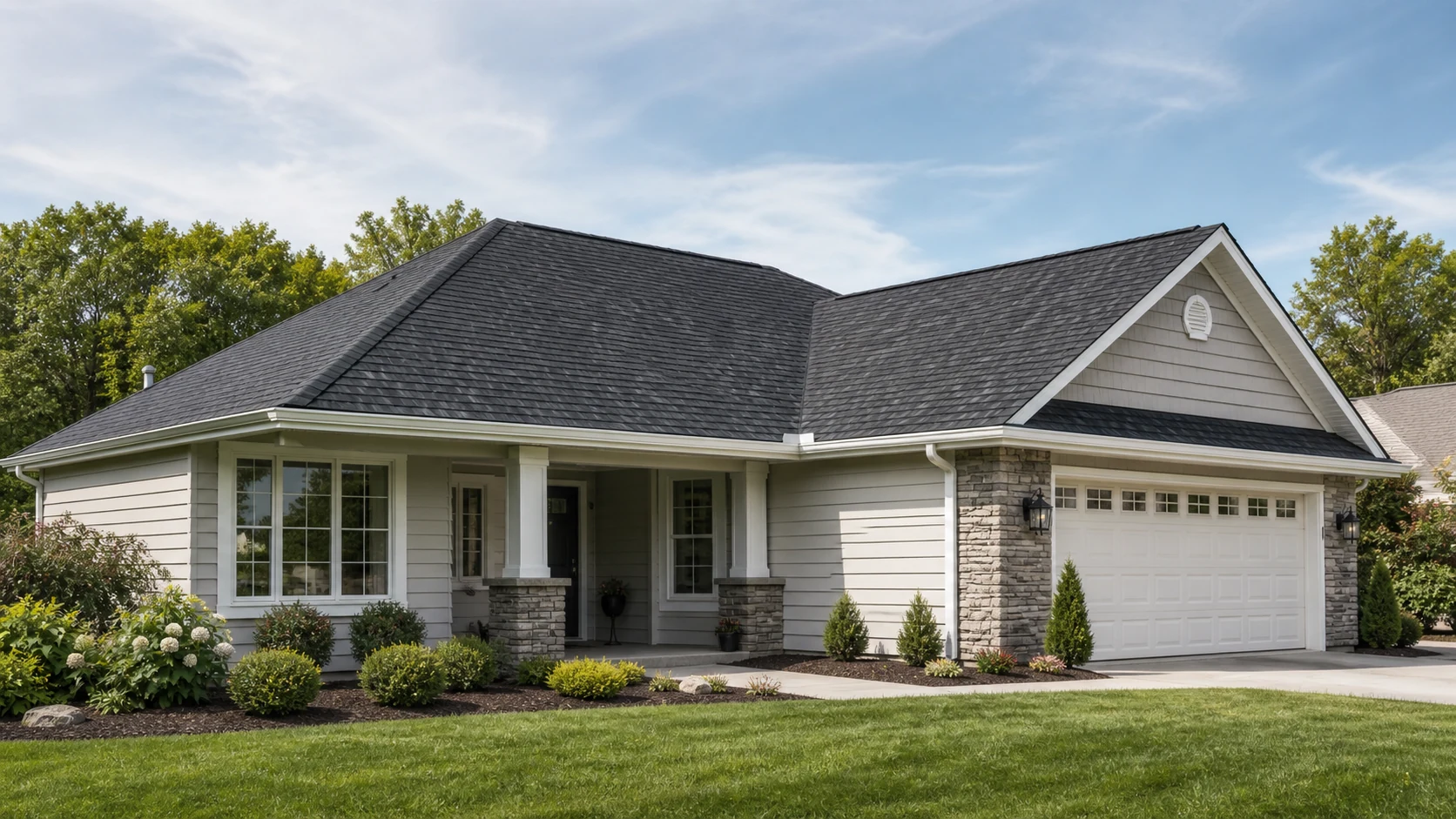
What is an asphalt shingle roof?
An asphalt shingle roof uses overlapping asphalt shingles as its primary water-shedding roof covering. Modern residential asphalt shingles typically use a fiberglass mat coated with roofing asphalt and surfaced with mineral granules.
The complete roof assembly also includes the applicable deck or sheathing, underlayment or membranes, edge details, flashing, starter material, field shingles, hip or ridge caps, and ventilation components where applicable.
Shingles shed water through overlapping courses. They do not make every roof detail watertight by themselves. Edges, penetrations, sidewalls, valleys, and ventilation openings need details suited to the assembly.
Roof-system components work together
The roof deck or sheathing provides the structural substrate. Underlayment covers the field where required, while a self-adhered membrane appears only where the selected assembly and local requirements call for it.
Drip edge belongs at roof edges. Starter material establishes the first shingle course. Flashing belongs at transitions, penetrations, and intersections. Hip and ridge caps cover only those high lines.
The figure shows locations and functions rather than a universal layer cake. The adopted code, exposure, roof geometry, and exact product instructions determine the final assembly.
Building America also emphasizes deck condition, flashing, underlayment, edge protection, and attachment when an asphalt roof is installed or replaced.
Types of asphalt roofing shingles
U.S. residential products commonly fall into three broad families. Manufacturers may use different product names, and no category guarantees one rating, service life, or installed performance.
| Product family | Common names | Typical identifying feature | What to verify |
|---|---|---|---|
| Strip shingles | 3-tab, strip | A flatter, repeating exposed pattern | Installed coverage, ratings, attachment, and permitted slope |
| Laminate shingles | Architectural, dimensional, laminate | Layered construction and a varied shadow pattern | Product-specific starter, nailing zone, coverage, and cap compatibility |
| Premium shingles | Luxury, designer, premium | A heavier or more distinctive profile intended to create a particular appearance | Weight, coverage, accessory system, ratings, and installation instructions |
“Performance shingle” is a product or market feature category, not a universal standardized fourth shingle grade. Read the exact specification instead of inferring performance from a marketing family name.
Ventilation and moisture management depend on the assembly
Asphalt shingles sit outside a larger heat, air, and moisture-control strategy. In a conventional vented attic, air sealing and insulation belong at the ceiling plane, while an unobstructed path can connect soffit intake with high exhaust.
Unvented roof assemblies use a different strategy. Do not add vents automatically or assume that one attic detail fits every climate and roof.
Moisture control also depends on flashing, underlayment, indoor humidity, roof-deck temperature, and drainage. A qualified designer or contractor should evaluate stains, condensation, wet insulation, recurring ice dams, or suspected deck deterioration.
Fire, impact, and wind ratings are different
A rating identifies performance in a defined test or classification. It does not convert directly into a universal field guarantee, and one rating does not substitute for another.
| Reference | What it addresses | How to read it carefully |
|---|---|---|
| UL 790 / ASTM E108 | Exterior fire classification of roof coverings, including Class A, B, or C | Class A is the highest classification in this system. It is not an impact or wind score. |
| UL 2218 | Impact resistance, Classes 1 through 4 | Class 4 is the highest classification in this test. It does not guarantee no hail damage. |
| ASTM D3161/D3161M-20(2025) | Fan-induced wind resistance of steep-slope roofing products | The method evaluates specimens under defined laboratory conditions; it does not directly reproduce every field wind condition. |
| ASTM D7158/D7158M-24a | Wind-uplift force and resistance methodology for sealed asphalt shingles | Use the applicable classification and code requirements with the product instructions. |
The current adopted code governs where it applies. The 2024 IRC, for example, references ASTM D7158 for asphalt-shingle wind classification and allows ASTM D3161 for products outside the scope of D7158. Local adoption and amendments still control a specific project.
How long does an asphalt shingle roof last?
No single lifespan range applies to every asphalt shingle roof. Service life depends on the exact product, installation quality, roof slope and geometry, heat and weather exposure, moisture, and whether the roof uses a properly designed vented or unvented assembly. Flashing and drainage details, deck condition, physical damage, and ongoing maintenance also affect how the system ages.
Keep four different ideas separate. A warranty term describes contractual coverage and exclusions. A laboratory or test classification describes performance under a defined procedure. Actual service conditions describe the heat, wind, moisture, drainage, and installation environment the roof experiences. Observed roof condition shows how the installed system is performing now. Evaluate an existing roof by its shingles, flashing, deck, leaks, movement, damage, and surrounding details rather than treating its age, warranty, or rating as a replacement date.
Advantages and limitations
Practical advantages
- Widely available for steep-slope residential roofs
- Multiple visual profiles and color blends
- Individual damaged areas can sometimes be evaluated without replacing every component
- Material quantities can be estimated from verified roof area and product coverage
Important limitations
- Wind, hail, heat, ultraviolet exposure, and moisture can affect condition
- Flashings and transitions remain critical even when field shingles look sound
- Different products use different coverage, accessories, and instructions
- No generic lifespan or rating proves the condition of an installed roof
Repair, recover, or replace?
A localized defect does not automatically require a complete replacement. The decision depends on the source and extent of damage, the condition of surrounding shingles, flashing, underlayment, deck, ventilation, and whether compatible replacement materials remain available.
A recover adds new roofing over an existing covering where permitted. It can conceal deck or flashing problems and may conflict with local requirements or product instructions. A tear-off exposes the deck so damaged sheathing and details can be evaluated.
Look beyond age alone. Missing or displaced shingles, widespread cracking, exposed shingle mat, recurring leaks, soft decking, failed flashing, and broad granule loss can justify a closer professional assessment.
Measure materials without mixing quantities
Start with actual sloped roof surface area, not a horizontal wall footprint. The Roof Square Footage Calculator converts projected geometry into sloped area.
Then add a project-specific waste allowance and use the installed coverage printed for the exact product. The Shingle Calculator keeps raw area, waste-adjusted area, whole bundles, and package-rounding coverage separate.
A simple gable roof and a regular hip roof create different cuts and intersection patterns. Roof complexity affects waste, but no preset is universally correct.
Common planning mistakes
- Treating shingles as the whole roof system.Deck, water-control layers, edges, flashing, caps, and ventilation details also matter.
- Reading every rating as one performance score.Fire, impact, and wind tests answer different questions.
- Assuming all products cover the same area.Verify installed coverage on the exact wrapper or specification.
- Using one universal waste percentage.Geometry, layout, product, and installation plan change the allowance.
- Choosing recover without inspecting the substrate.Existing layers and deck condition can change the appropriate scope.
- Relying on age alone.Evaluate current condition, details, exposure, and leak history.
Technical references
Asphalt shingle roof questions
What is an asphalt shingle roof?
An asphalt shingle roof uses overlapping asphalt shingles as its primary water-shedding covering. Modern residential products typically use a fiberglass mat coated with roofing asphalt and surfaced with mineral granules. The full roof system also includes the applicable substrate, water-control layers, edge and transition details, and ventilation components.
What is the difference between 3-tab and architectural shingles?
Three-tab or strip shingles usually have a flatter, repeating exposed pattern. Architectural, dimensional, or laminate shingles use laminated construction to create a thicker, varied profile. Product ratings, coverage, installation details, and warranties still depend on the exact product.
What do Class A fire and Class 4 impact ratings mean?
They come from two different test and classification systems. Class A is the highest exterior fire classification under UL 790 or ASTM E108. Class 4 is the highest impact classification under UL 2218. Neither classification guarantees that a complete roof will avoid damage in every real fire or hail event.
How long does an asphalt shingle roof last?
There is no universal service life. The exact product, installation, roof geometry, exposure, moisture control, flashing, drainage, deck condition, physical damage, and maintenance all affect the outcome. Treat the warranty term and laboratory classifications as product documents, not predictions of service life. Judge an existing roof by its actual service conditions and observed condition.
Can asphalt shingles go over an existing roof?
Some projects may permit a recover, while others require removal. Existing layers, deck condition, local requirements, manufacturer instructions, weight, flashing, and surface condition affect that decision. Confirm the adopted code and have the existing assembly evaluated before choosing recover or replacement.
How many shingles do I need?
Start with actual sloped roof area, add a project-specific waste allowance, and convert the adjusted area using the installed coverage stated for the exact product. The Shingle Calculator performs that package conversion without assuming a universal number of individual shingles.
Work safely. Use plans, aerial measurements, or accessible interior references instead of climbing onto a roof. OSHA fall-protection requirements apply to covered residential construction work at height.